
Santan Rekha in Palmistry: How to Read the Children Line on Your Palm
Palmistry · The Astrology Academy of India · 6 min read

Ask any palmist in India what people want to know most, and the answer is almost always the same: love, career, and children. For questions about family, palmistry has a specific place to look. It is called the Santan Rekha, or the children line in palm reading.
In this blog, we will explain what Santan Rekha is, where to find it, how to read it, and what it can and cannot tell you.
What Is Santan Rekha?
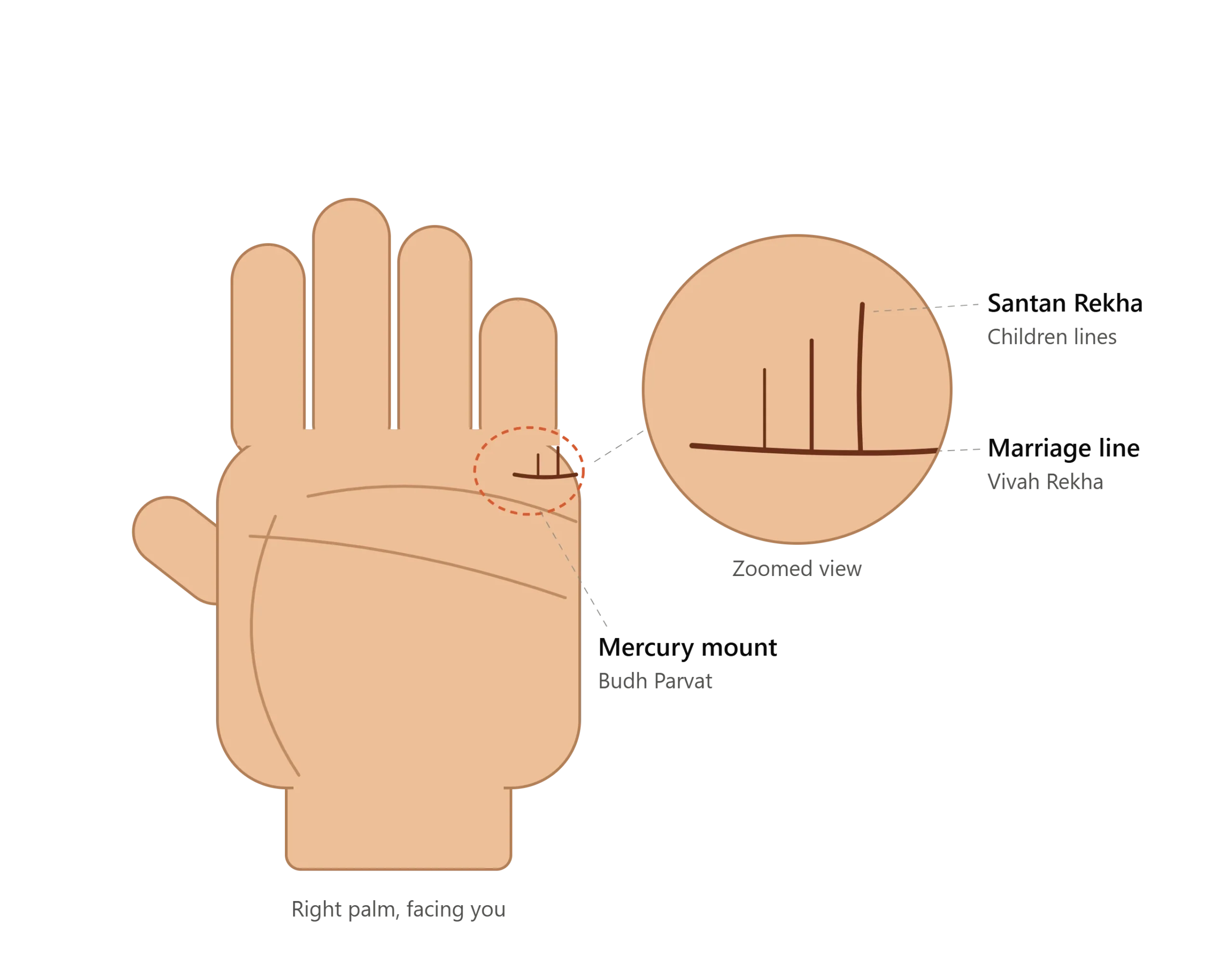
In Hast Rekha Shastra, or Indian palmistry, Santan Rekha means the small vertical lines on the outer edge of your palm, just below the little finger. People also call them children lines or progeny lines.
These lines are usually short and fine, so they are easy to miss. Many people also confuse them with the marriage line, which runs sideways. The difference is simple: the marriage line is horizontal, while Santan Rekha are the small lines that stand upright above it.
Where to Find Santan Rekha on Your Palm
Look at the fleshy pad right below your little finger. This is the Mercury mount, also called Budh Parvat. Now find the horizontal line that enters your palm from the outer edge. That is your marriage line, or Vivah Rekha.
The small lines that rise upward from the marriage line, or cut across it vertically, are your Santan Rekha.
Quick tip
Check your palm in natural light and bend your little finger slightly. The lines show up much more clearly. A magnifying glass helps too.
How Santan Rekha Is Traditionally Read
Palmistry follows a few classical rules. These are the ones you will hear most often.
Number of lines
Traditionally, each clear vertical line points towards one child. Experienced palmists treat this as a general indication, not an exact headcount
Depth and length
A deep, long, well-defined line is seen as a strong sign. A faint or thin line is read as weaker. Old texts link deep lines with sons and thin lines with daughters, but most modern palmists do not treat this as reliable
Broken or faded lines
A break is sometimes read as a delay or a gap between children. It does not mean something bad will happen. Palmists usually consider the overall pattern of the line before giving any interpretation
Islands and crosses
An island, a small oval loop, is traditionally linked with health worries or some struggle in that phase. A cross may show a hurdle. These are signs to be aware of, not fixed outcomes
Forked lines
A line that splits at the top is sometimes read as a child with two strong interests, or one who may live away from home. The meaning is generally considered along with the other markings and the overall condition of the palm
Length of the Marriage Line Matters Too
A good palmist never reads Santan Rekha alone. Its strength is judged along with the marriage line. If the marriage line is long, clear, and healthy, the children lines above it are said to carry more weight. If the marriage line is broken or weak, the reading changes.
Other Areas Palmists Check
Santan Rekha is only one piece of the picture. Before saying anything about children, a trained reader also looks at these:
- Mercury mount: a full, well-raised mount is seen as supportive of family life.
- Venus mount: shows warmth, affection, and vitality.
- Moon mount: linked to imagination and emotional depth.
- Heart line: a clean heart line supports emotional stability in relationships.
This is why a proper palm reading takes time. One line rarely tells the whole story.
Which Hand Should You Read?
In Indian tradition, the right hand is generally read for men and the left hand for women, though many modern teachers advise reading both.
Right hand
Shows what you have made of your life so far
Left hand
Shows what you were born with
When both hands show similar Santan Rekha, the reading is considered more reliable.
Do Santan Rekha Change Over Time?
Yes, they can. Palm lines are not fixed for life. Small lines like Santan Rekha can grow deeper, fade, or even appear later. This is why palmists often say your hand is a living map, not a stone tablet.
An Honest Word of Caution
Palmistry is a traditional knowledge system, best used for guidance and self-reflection. It cannot replace medical advice. If you are worried about fertility or family planning, please speak to a qualified doctor first.
And if someone makes a dramatic prediction based on one small line, be careful. A responsible palm reader never scares people.
Want to Learn Palmistry Properly?
Reading Santan Rekha correctly takes practice. You need to spot the lines, understand the mounts, compare both hands, and speak carefully with the person in front of you. That is not something you pick up from a few videos.
At The Astrology Academy of India, our palmistry course teaches this step by step, from the basics of the palm map to detailed line reading. We also offer Vedic Astrology, Numerology, Tarot, Vastu Shastra, Face Reading, and Nakshatra. Our institute is registered under the Govt of NCT of Delhi, and our classes suit beginners as well as serious learners.